
2026 Pool Design Trends in Port Charlotte, Florida
The pool design trends Port Charlotte homeowners are building in 2026 look very different from the pools that went in ten years ago. Backyards across Charlotte County are being planned as complete outdoor living spaces instead of a rectangle of water with a deck around it, and the features people are willing to spend money on have shifted. Here is what SFC Pool Corp. is actually designing and building right now for homeowners in Port Charlotte, Punta Gorda, North Port, Englewood, and the surrounding Southwest Florida communities.
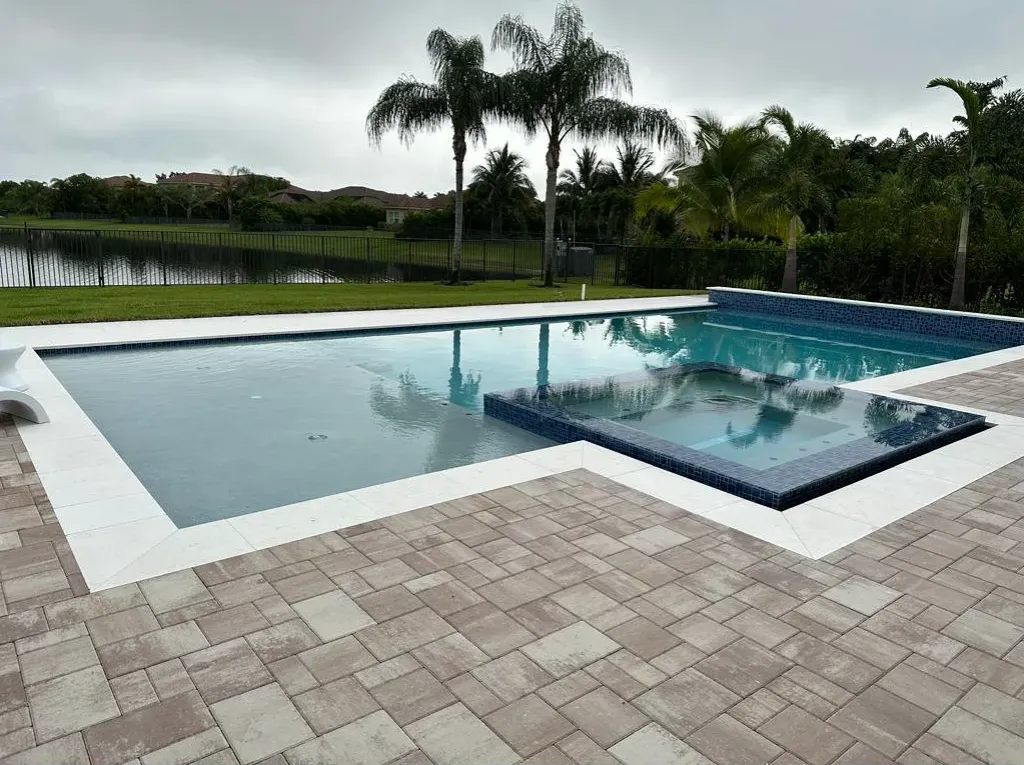
What are the biggest pool design trends in Port Charlotte for 2026?
The ten trends driving custom pool design in Port Charlotte and Charlotte County this year are:
- Tanning ledges and Baja shelves
- Smaller pools with a bigger features budget
- Clean, modern geometric shapes
- Integrated and raised spas
- Darker interior finishes
- Smart pool automation
- Lighting designed for evening use
- One or two intentional fire and water features
- Screen enclosures designed in from day one
- The pool and the outdoor living area planned together
Each one is worth understanding before you sit down for a design consultation, because the decisions you make early are the expensive ones to change later.
1. Why are tanning ledges the most requested feature in Port Charlotte pools?
The tanning ledge, also called a Baja shelf or sun shelf, is the single most requested feature in new Southwest Florida pools. It is a shallow area, usually somewhere between six and twelve inches deep, where you can sit or lounge partially in the water without being fully submerged.
It works here for a specific reason. Port Charlotte summers are hot enough that shade and shallow water get used far more than deep water does, and a ledge gives you a place to cool off that does not require swimming. It is also the safest spot in the pool for young kids and the easiest entry point for older adults and anyone with joint issues.
Tanning ledges are being built with:
- In-water lounge chairs
- Umbrella sleeves cast into the shelf
- Bubblers
- Built-in bench seating
- Dedicated LED lighting
If you only add one feature to a new pool, this is usually the one that earns its cost back in daily use.
2. Are smaller pools a smarter choice for Port Charlotte lots?
Often, yes. Many Port Charlotte homesites, especially the older platted lots and the Gulf-access canal properties, have limited rear yard depth once you account for setbacks, easements, and seawall clearances. Rather than pushing water out to every available inch, homeowners are right-sizing the pool and moving budget into the things they use every day.
That freed-up space and budget is going toward:
- Outdoor kitchens and grill stations
- Covered and shaded seating
- Fire features
- Landscaping and privacy planting
- Upgraded tile, coping, and interior finishes
- Pool automation and better equipment
- Larger paver deck for entertaining
A well-proportioned pool with a generous deck almost always lives better than an oversized pool crowded against the screen enclosure. Taken far enough, that same thinking produces a spool, the compact pool with spa comfort that is replacing full-size pools on tight Port Charlotte lots.
3. What does a modern geometric pool look like in Southwest Florida?
Straight lines, squared corners, and simple architectural detailing continue to dominate new construction across Charlotte and Sarasota counties. Geometric shapes sit well against the newer Florida homes going up in Port Charlotte, Babcock Ranch, and West Villages, and they make better use of a rectangular lot than a freeform shape does.
The combination showing up most often is a geometric pool with a tanning ledge, an integrated spa, and large-format pavers or travertine decking. It reads clean and resort-like without becoming complicated, and it ages better than a heavily themed design.
Shape is also tied to how the pool is built. If you are weighing structure and longevity, our breakdown of gunite versus fiberglass pools in Florida covers why custom shapes and gunite construction usually go together.
4. Should you add an integrated spa to your pool?
Integrated spas are one of the strongest trends of 2026. Instead of setting a separate hot tub off to the side, the spa is designed into the pool structure itself so it reads as part of the architecture.
Depending on your layout and grade, the options include:
- Raised spas that create a vertical focal point
- Spillover spas that flow into the pool
- Flush or attached spas set at deck level
- Built-in spa seating and loungers
- Dedicated spa lighting
A raised spillover spa does double duty in Southwest Florida. It gives you a warm-water space for the handful of genuinely cool evenings we get from December through February, and the spillover provides moving water and sound year-round.
5. Are dark pool finishes a good idea in the Florida sun?
Deep blues, charcoal, slate, and other dark interior finishes have gained real ground with homeowners who want a dramatic, upscale look. They pair well with neutral decking, modern glass tile, and simple landscape design, and they give the water a reflective, lagoon-like depth.
There is a tradeoff worth knowing before you commit. Darker finishes absorb more solar heat, which is welcome in January and less welcome in August, and they show surface deposits differently than a light finish does. Water chemistry matters more with dark finishes, so the finish decision and your sanitization decision should be made together. If you are still weighing that, our comparison of saltwater versus chlorine pools in Florida is a good place to start.
The right finish is the one that complements your home, your deck material, and your pool shape, not simply the one that is trending.
6. What can smart pool automation actually control?
Automation has moved from a luxury upgrade to something most new builds include. From a phone app or a wall-mounted controller, a modern system can manage:
- Pool and spa temperature
- Variable-speed pump schedules
- Pool, spa, and landscape lighting
- Water features and bubblers
- Heating and cooling schedules
- Sanitization and equipment status
Automation is especially valuable for Port Charlotte and Punta Gorda seasonal residents. Being able to see equipment status and adjust run times from out of state is the difference between arriving to a swim-ready pool and arriving to a problem.
7. How should a Florida pool be lit for evening use?
Half the value of a Southwest Florida backyard happens after sunset. From roughly November through April, the evenings are the most comfortable hours of the day, and a pool that was only designed for daylight gets left unused.
Layered lighting is the current standard, with fixtures worked into:
- The pool interior and spa
- Steps, benches, and the tanning ledge
- Water and fire features
- Landscape and palm uplighting
- Deck perimeter and screen enclosure columns
Good lighting is a safety feature as much as a design feature. Lit steps and defined pool edges matter when the family is still outside at nine o’clock.
8. How many fire and water features should a pool have?
Usually one or two, chosen deliberately. The trend in 2026 is restraint. Rather than stacking every available feature into one pool, homeowners are picking a single statement element and letting it carry the design.
Popular choices include fire bowls on raised walls, sheer descents off a raised spa, deck-level bubblers on the tanning ledge, and fire-and-water combinations where a bowl sits directly above falling water. Any of these done well beats four of them competing for attention.
9. Why should the screen enclosure be part of the pool design?
This is the trend that is specific to Charlotte County, and it is the one homeowners most often overlook. In Port Charlotte, a screen enclosure is not an afterthought. It controls insects, cuts down on debris and pollen, adds shade, and provides a barrier layer around the water.
The enclosure needs to be planned at the design stage, not added afterward, because it determines:
- How much usable deck you actually end up with
- Where footers and columns land relative to the pool shell
- Whether a raised spa, fire feature, or umbrella will physically fit under the roofline
- Sight lines to the canal, lake, or preserve behind your home
- How the structure is engineered for Southwest Florida wind loads
Designing the pool and the cage together is the difference between a backyard that feels open and one that feels boxed in.
10. Why is outdoor living now part of the pool design?
The biggest shift of all is that the pool is no longer designed in isolation. The pool, the deck, the lanai, the outdoor kitchen, the landscaping, the lighting, and the entertaining space are being drawn together as one plan.
That produces a backyard that works for swimming, dining, entertaining, and everyday family time instead of a pool with some furniture near it. Our design and build process is structured around this, so the layout, materials, and features are coordinated before the first permit is pulled.
What does Port Charlotte’s climate mean for your pool materials?
A pool that looks right and a pool that lasts here are two different problems. Southwest Florida brings intense UV, sustained heat and humidity, a heavy summer rainy season, and, for homes along the Gulf-access canals and near Charlotte Harbor, salt air that is hard on metal.
Those conditions should drive real decisions about deck material and surface temperature, tile and coping durability, corrosion-resistant equipment and fasteners, drainage and grading for rainy season runoff, and enclosure hardware selection. Getting these right at design time costs nothing extra. Correcting them later costs a lot.
Site conditions matter just as much as materials, which is why a current property survey is the first step in any Florida pool build.
What would a 2026 SFC pool in Port Charlotte look like?
Combine the strongest trends of the year and you get a clean geometric pool with a full-width tanning ledge, a raised spillover spa, a premium interior finish, modern waterline tile, large-format pavers, layered LED lighting, smart automation, one well-chosen fire or water feature, and a screen enclosure and outdoor living area designed around all of it.
That said, trends are a starting point, not a plan. The best pool is the one designed for your lot, your home, your budget, and the way your family actually uses a backyard.
Frequently asked questions about building a pool in Port Charlotte
How much does a custom pool cost in Port Charlotte, FL?
Most new custom inground pools in Southwest Florida run from roughly $45,000 to $100,000 or more depending on size, finishes, and features. A straightforward pool with a paver deck sits at the lower end, while larger pools with integrated spas, premium decking, and full outdoor living areas move toward the upper end. Our guide to inground pool installation in Southwest Florida breaks the numbers down further, and financing through Lyon Financial is available.
Do I need a permit to build a pool in Charlotte County?
Yes. A residential pool in Charlotte County requires a building permit, a current property survey, and engineered plans, plus inspections during construction. Florida law also requires new residential pools to include an approved safety feature, such as a barrier, a safety cover, or door and window alarms. SFC Pool Corp. handles the permitting and inspection process as part of every build.
How long does it take to build a pool in Port Charlotte?
Once construction begins, most SFC Pool Corp. builds finish in 30 to 90 days. Permitting, engineering, and site preparation happen before ground breaks, and those timelines vary across Charlotte, Sarasota, Lee, and Manatee counties, so starting early is the best way to have your pool ready when you want it.
When is the best time to start a pool project in Southwest Florida?
Pools are built here year-round, but many Port Charlotte homeowners start in fall or winter. The dry season means fewer weather delays, and finishing before spring means the pool is ready for the first genuinely hot stretch of the year.
What areas does SFC Pool Corp. serve?
SFC Pool Corp. builds custom pools throughout Southwest Florida, including Charlotte, Sarasota, Lee, and Manatee counties, serving Port Charlotte, Punta Gorda, North Port, Englewood, Rotonda West, Venice, Sarasota, Cape Coral, and Fort Myers, with additional service in Broward and Palm Beach counties.
Ready to design your Port Charlotte backyard?
If you are ready to turn these ideas into a real design for your property, SFC Pool Corp. is ready to help. Call 941-249-9716 or start your custom pool design to schedule a consultation.
SFC Pool Corp. Your paradise begins in your backyard.